As the well-dressed patrons duck into the Hudson Theatre from the steady Manhattan rain outside, they are greeted by the sight of a lone woman, seated on stage, slowly rotating in a long circle. High above her head is the projected number 1879.
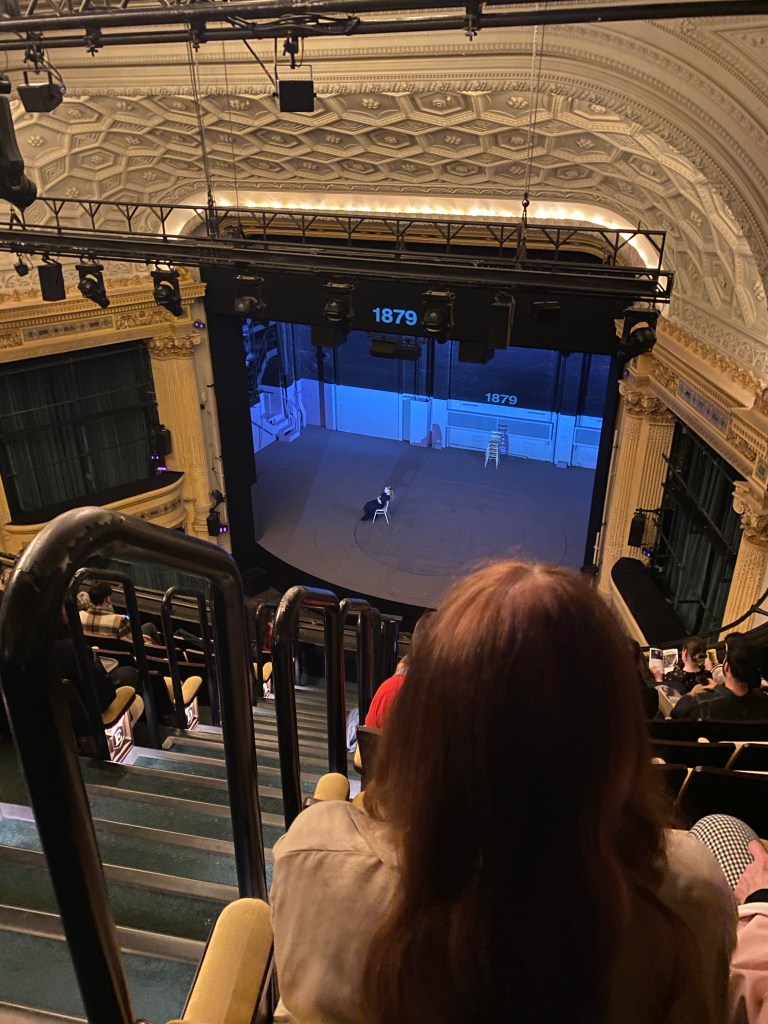
So begins A Doll’s House, a modern remake of the original three-act play written by Norwegian playwright Henrik Ibsen in 1879. We are at once welcomed into the home of the main character, a housewife named Nora (played expertly by Jessica Chastain, known for her role in The Help) who seems to have the idyllic lifestyle: wealth, affluence, a loving husband, children, friends.
But this is only the cover of the book. The pages within reveal a darker story. Nora is hiding a secret from her husband Torvald (played by Arian Moayed). She borrowed a large sum of money from shadowy loan shark which she has not figured out how to repay. She pretends all is well to her husband, feeding his need for a woman that is full of cheer and fits the model of the pliant, irreproachable wife that he expects, the frame and role he has created for Nora…indeed for all women.
It is through this lens that we quickly begin to see that the looming financial problems are not Nora’s true issue. Indeed, they are only the symptom. Nora struggles to find her independence in a world designed to program women under the control and subversion of others (i.e. men). Indeed, the taking out of the loan itself is a small act of rebellion as Chastain’s character notes that usually her husband is the controller, the manager of the household’s finances. He does not think or trust her capacity to do so. Nora takes a certain glee in her ability to take not only facilitate this loan, but hide it from Torvald, while also beginning to question why this should be the case in the first place.
The set’s minimalist approach to props only enhances this darkness, this emptiness that Nora feels. We begin to feel this as the audience as we watch the characters only use chairs to rotate about the stage. There is no sign of a house, food, backgrounds, changes of color or any scenery. Indeed, there is no sign of A Doll’s House. It is an invisible house, one where Nora feels inevitably trapped. Slowly, she begins to claw against the invisible bars of the house, trying to find her way out, trying to keep up the ruse so her husband doesn’t discover her dirty secret, while more and more admitting her vulnerabilities. This is shown in her incognito conversations with the loan shark, Nild Krogstad (played by Okieriete Onaodowan, known from Hamilton’s original cast) as she pleads with him to not tell her husband about the loan, and also in the conversations with her old friend, Kristine (played by Jesmille Darbouze), who needs a job from Nora’s husband. Nora comes to see that the loan is the least of her worries. Confronting her unhappy role in life and in society is what truly frightens her.
The cast is quite skilled and all play the stage well together. Chastain gives a marvelous performance and I was surprised at how much better she is on stage than on screen as she fully encapsulates the role and spirit of Nora, giving the play a life that it would lack otherwise. Both Onaodowan and Darbouze bring their talents to a level that easily complement Chastain’s, adding an easy and enjoyable variety and balance to her.
Catch A Doll’s House on Broadway, playing through June 10th.
 The Wandering Foodie
Leave a comment